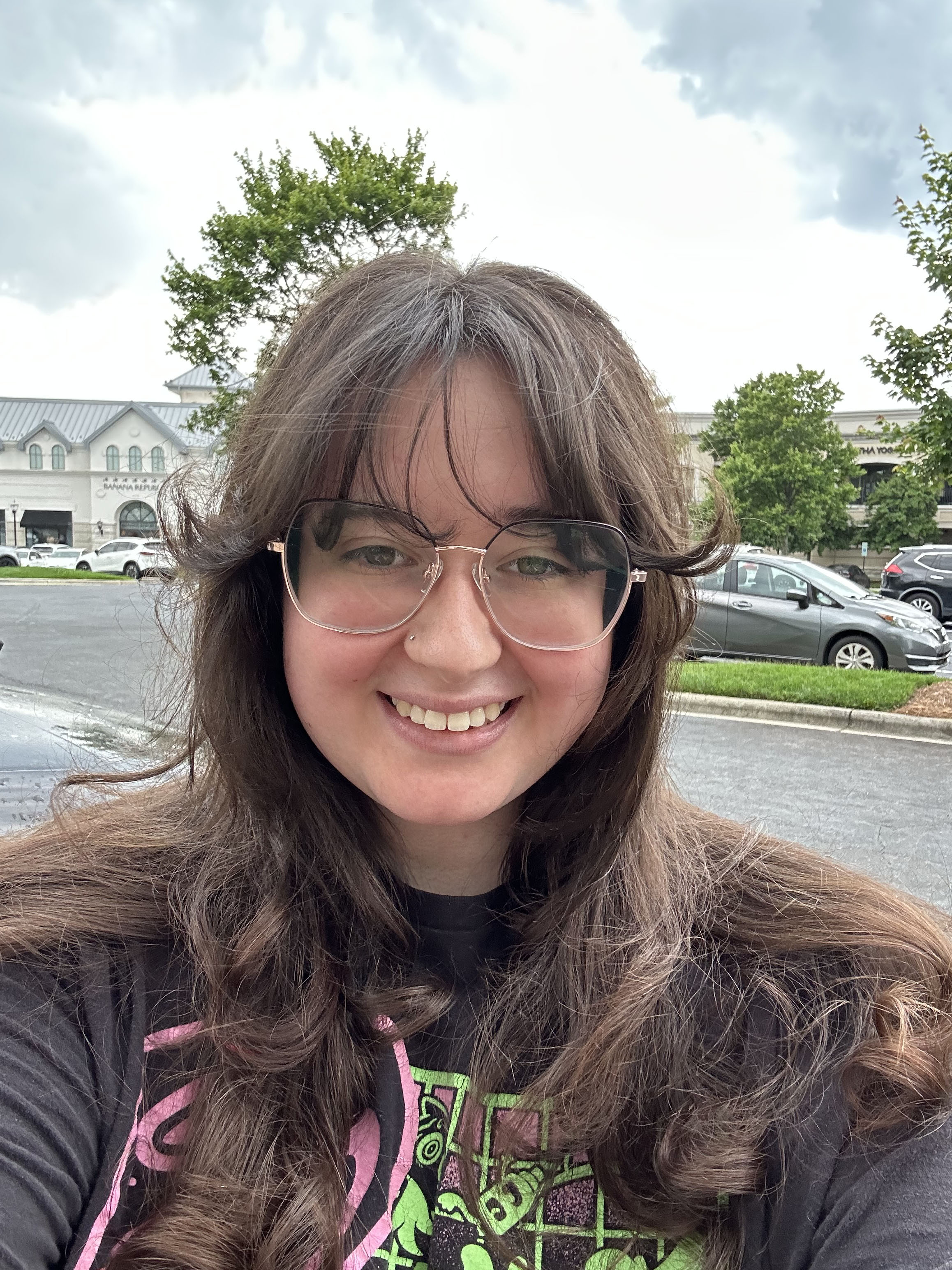
Cassidy works on the Expanded Extending Extension grant project as a digitization assistant in the SCRC Digital Program.
Cassidy works on the Expanded Extending Extension grant project as a digitization assistant in the SCRC Digital Program.
The Special Collections Research Center blog series "Student Spotlight" features student employees who contribute to the work of the SCRC. Guest author Cassidy Mateo, class of 2027, is a graduate student in the School of Information and Library Science at UNC Chapel Hill, working towards her Master of Science in Library Science. Cassidy has worked as a Digital Program Digitization Graduate Assistant on the Expanded Extending Cooperative Extension History (3X) project in SCRC since September 2025.
Please describe in a sentence or two the work that you do in the Special Collections Research Center.
I work at the Special Collections Research Center digitizing photo negatives and slides. My work primarily involves agricultural scenes, 4-H clubs, and portrait images. I help preserve and provide access to these historical materials through the use of special scanning equipment and program tools.
What has been most interesting to you about your work? What new things have you learned? Have you made any surprising discoveries?
The most interesting part of my work has been seeing how everyday agricultural activities impacted the North Carolina landscape. Even though I grew up within similar spaces to the ones in the photos I digitize, I realize now the broad depth of changes since the late 1960s. Agricultural life in North Carolina is not gone, but it is much smaller and needs to be protected and preserved more than ever.
I have also been struck by how personal and detailed some of the 4-H and Agricultural Extension employee portraits are. Sometimes I feel like you can tell the sort of person they were just from the photo! It is a bit silly, but you start to feel like you know them! When I see recurring faces, it makes me glad to see them again, like an old friend. Though the best photos to work on by far are people and their pets! Several 4-H clubs had activities with their dogs, horses, or farm animals, and it is a sweet look into the lives of these once-cherished animals. I have learned a lot about digitization workflows and handling fragile photographic materials as well. My prior experience with digitization was with text-based items, so the 3x project has been a great learning experience in photo editing.
If you met someone who was unfamiliar with archives and special collections, what would you want them to know? What should new researchers know about the work you do?
If I met someone unfamiliar with archives and special collections, I would want them to know that archives preserve everyday life just as much as major historical events. Yes, maybe collections of photos that include famous people are more ‘fun’ to work on, but I started my journey into preservation intending to take the lesser-known path. The average person has an equally exciting life, with all the highs and lows of a Hollywood star!
That, and the work we do behind the scenes, such as careful handling, description, and digitization, all help to ensure these materials remain accessible in the future. New researchers should also know that above all, archivists and staff are there to help! The collection can feel overwhelming at first, but our goal is to support discovery and make research as approachable as possible.
What are you studying, and what do you hope to do in your future career? Has your work in the SCRC changed how you look at your studies or your future career plans in any way?
Right now, I am a first-year graduate student at UNC Chapel Hill studying library science. I have a few paths I would like to explore in the future, such as visual resource management and archival duties including cataloging and description. The SCRC has gotten me significantly more interested in metadata processes and accessioning. In the future, I hope to explore these areas even more!
Opens in your default email client
URL copied to clipboard.